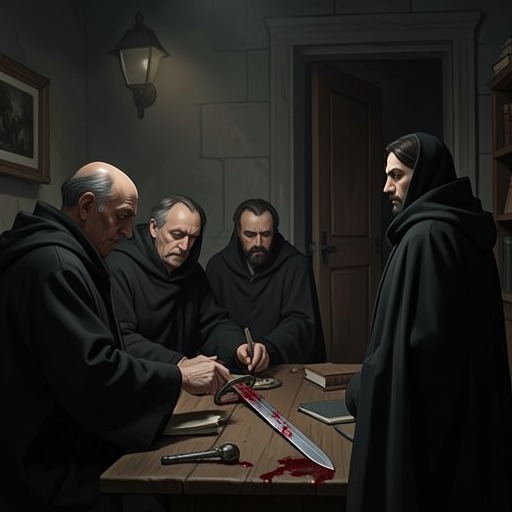
Glamiss and Candor’s rebellion against Duncan
The KillerGlamiss and Candor’s rebellion against Duncan is a failed-looking but unresolved bid for power: the conspirators plan to depose Duncan and divide the throne, yet the battle leaves Candor captive while Glamiss escapes with part of his forces. The episode’s starkly theatrical battlefield, rendered through gunfire, storm effects, a red sky, and isolated cries, makes military violence palpable without presenting it naturalistically; its later reversal denies the apparent finality of Duncan’s victory.
The Alliance and Its Ambition
Glamiss and Candor approach one another and look toward the entrance of Banco, greeting him as a gallant general and great captain. This welcome places the rebel leaders in the company of a military figure whose presence matters to their challenge to Duncan. The exchange establishes the scene’s movement from a private alliance toward a larger contest involving armed forces, although the evidence does not describe Banco joining their plan at this point.
The rebels’ immediate objective is explicit. Glamiss proposes that they prepare weapons, gather men, and ready their armies for an attack at dawn; he expects Duncan to be beaten by the following evening and proposes that the victors share the throne. The timetable gives the conspiracy the form of a coordinated campaign, while the promised division of sovereignty identifies its political reward. This is not merely a protest against Duncan’s rule: the rebels intend to replace him and take the power they condemn.
Candor asks whether Glamiss truly considers Duncan a tyrant. Glamiss answers with a catalogue of accusations, calling Duncan a tyrant, usurper, despot, dictator, miscreant, ogre, ass, and goose, then makes the blunt claim that Duncan’s possession of power is itself proof. He presents his motives as honorable, but his own reasoning ties the charge of illegitimacy to the fact that Duncan rules, while his stated end is a share of the throne. The scene consequently sets the language of resistance against the rebels’ plainly stated ambition, without resolving the sincerity of either man’s political convictions.
The Battle as Stage Event
The battle is represented after Glamiss and Candor leave in opposite directions, having sheathed their swords. A pause empties the stage. The directions then call for an extended transformation of light and sound rather than a naturalistic depiction of fighting: shots and flashes ripple across the scene, a conflagration appears in the sky, and a bright overhead light may be reflected onto the stage amid storm and lightning. The battle reaches the audience through theatrical signs of violence rather than through a narrated account of maneuvers or a visible sequence of combat.
As the sky clears, it turns red, described in the directions as beautiful and tragic. Machine-gun fire becomes less frequent and recedes; shouts, death rattles, and the groans of wounded people remain, followed by further shots and the shrill scream of a wounded man. The clouds clear onto a large deserted plain, and the man’s scream stops. After a short silence, a woman screams. The directions specify that this passage should continue for a long time and that its lighting and sound should remain nonnaturalistic, particularly toward the end. The prolonged transition from battle noise to deserted silence gives the apparent end of fighting an unsettled, staged quality rather than a simple report of victory.
Apparent Defeat and Capture
The next scene announces that the battle is over. Blazing fanfares and cheering accompany Duncan’s entrance; Macbett and Banco’s Head greet him, and Macbett says the danger has passed. Duncan responds with relief and asks whether Candor has been executed. Macbett says that Candor has instead been taken prisoner. Duncan questions why he was not killed and what is being awaited; Macbett answers that he is awaiting Duncan’s orders. Candor’s capture is therefore clear, but his fate is not yet settled: Duncan’s question makes execution an immediate possibility, while Macbett’s reply leaves the decision to the ruler.
The pause between the battle’s stylized violence and Duncan’s ceremonious entrance produces a sharp contrast. The previous scene has left a deserted plain, cries, and silence; the new one presents the ruler amid fanfares and cheering. Duncan treats the danger as past, but the prisoner’s status leaves a consequential decision open. The apparent victory is expressed through ceremony and control over Candor, not through a complete account of what became of every rebel force.
Escape and Renewed Uncertainty
Later, as Duncan addresses Macbett and Banco about duties and obligations in return, an officer interrupts to report that Glamiss has escaped. The officer repeats the news and adds that part of Glamiss’s forces have rallied to him. Banco stops guillotining and comes downstage; the other characters jump up. His response emphasizes that Glamiss had been surrounded and seemed as good as taken, before he declares that there has been a conspiracy. The report thus reverses the earlier impression of an ended danger: one rebel leader is a prisoner, but the other has escaped with a regrouped portion of his forces.
The escape changes the battle’s consequence without erasing its losses or resolving Candor’s fate. Duncan had called the danger over, yet Glamiss’s renewed command makes that confidence premature. The rebellion’s aftermath is marked by an imbalance: Candor is under the ruler’s authority, while Glamiss remains at large with supporters. Banco’s interruption of the guillotining gives the news an immediate physical consequence onstage, and his suspicion of conspiracy directs attention from the battlefield’s apparent conclusion to continuing political danger.